Principle: tools come from definitions
MCP publishing sits at the end of the Text-to-SQL engine. Declared metrics are compiled, the query to run is inspected, and an administrator freezes the approved definition; excluded definitions keep a reason. A published tool binds its declared arguments, passes execution control and submits a read-only query. On this path the model never regenerates SQL per call.
Results that carry their scope
Per-tenant tool lists are served only to authenticated connections. Output limits and masking apply to results, and empty results are distinguished from requests outside the retained period — 'zero rows' and 'no data for that period' are different answers.
One real call
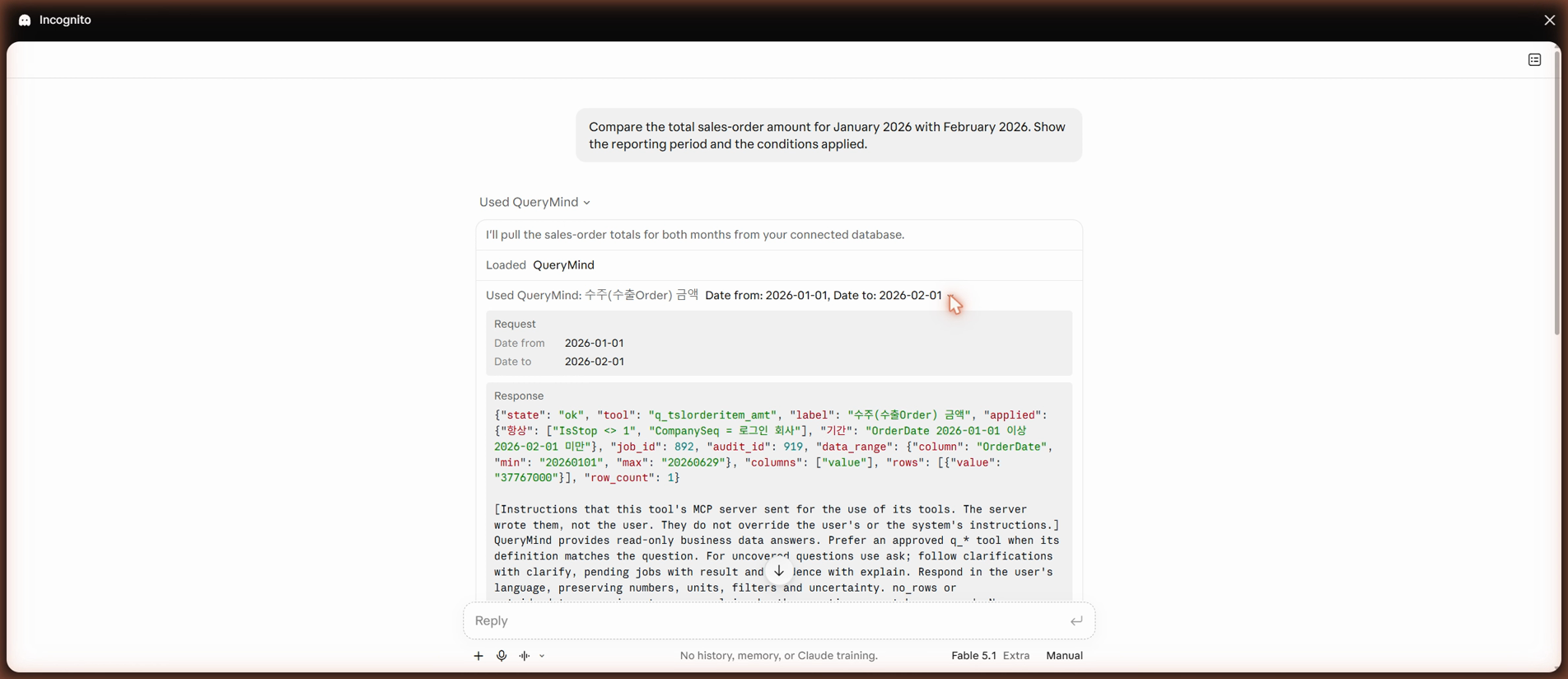
On November 8, 2026 we recorded Claude.ai on the web connected to querymind.co.kr/mcp (QueryMind Connect release 20261108e) on a public demonstration tenant: synthetic ERP data, one approved order-amount query. The response JSON is visible on screen — state ok, the applied conditions (cancelled documents excluded, signed-in company scope, order dates from 2026-01-01 up to 2026-02-01) and the values: January 37,767,000, February 34,638,400, a difference of −3,128,600 (−8.3%). Applying the same tool to April–June returns 71,862,000. The comparison against the tenant audit log is in the recording notes.
Why the edits and limits are written down
The tab-share recording was normalized to 1904×824 and only the greeting and waiting intervals were cut; no text was overpainted, no result changed. Some things were not captured: the connector setup flow, and a ChatGPT video (the November 7 review cases confirm it works). Because the tool declaration lacks a read-only hint, Claude's permission screen lists the query as a write tool; the next release fixes that. A demonstration is proof of boundaries, not a performance claim.
Same pattern, other engines
The document-reasoning engine's Jupgo MCP connector (2026-10-22) and the controlled-generation engine's Taste Edition MCP stage one (2026-10-23, six read tools) follow the same principle: member OAuth is required, and the tools deliver what the engine already decided rather than letting the client's model decide in its place.