The problem: valid SQL that answers a different question
A query that runs without error can still count something the user never asked about. Which table and column 'order count' means, which period and scope apply, whether an aggregate word like 'total' is a unit — none of this is for a model to guess. So this engine looks for accuracy in declarations rather than prompts.
Semantic layer: binding terms to contracts
A domain pack maps business terms and synonyms to declared metrics, dimensions and concrete columns. The Semantic Resolver interprets terms only within the selected data scope, and ambiguous values stop at a gate. Since July 9, 2026 the pack's standard table names are mapped to the customer's real tables, and since July 19 the pack's metric definitions are injected by the server directly into the SQL syntax tree. That was the turning point from asking the model to enforcing a contract in the compiler.
Validation layer: rejecting in the syntax tree
Generated SQL is parsed with sqlglot and inspected as a tree. Only a single SELECT is allowed. Insert, Update, Delete, Merge, Create, Drop, Alter, TruncateTable, Command and Copy nodes, multiple statements, unresolved Placeholder/Parameter nodes and anonymous functions outside the allow-list are rejected before execution. The code comments also say plainly that syntax checks complement semantic checks and do not establish that a query answers the right question.
Execution layer: read-only, caps, rechecks
The approval route checks ownership and prior validation, then rechecks live permissions; a changed organization context or revoked grant stops even a prepared query. The collector connects with a read-only account, sets a session statement_timeout, and refuses to run when the EXPLAIN-estimated cost or row count exceeds the cap. Adapters without EXPLAIN fall back to timeout and LIMIT. There are five adapter families: PostgreSQL, MariaDB/MySQL, SQL Server, Oracle (including 11g) and SAP HANA.
Evidence layer: tying numbers to results
Figures in an answer are checked against returned values and units (numeric grounding). Audit records keep the question, query, approval and execution context, and per-stage timings — generation, model attempts, queue wait, composition — measured since August 17, 2026 and used as the baseline for field tuning.
What the field taught
On July 23 an experiment adding few-shot examples ended with zero improvement in five live checks and was closed with a record. On September 12 a defect that bound count questions to sum metrics, blocking a correct COUNT query, was fixed with a count-intent gate; on September 16 came the rule that totals are neither units nor business terms. On September 3 we found 6,460 column descriptions with Korean business terms replaced by English abbreviations, stopped, and escalated to the owner. Accuracy came from meaning definitions and data quality, not from the model.
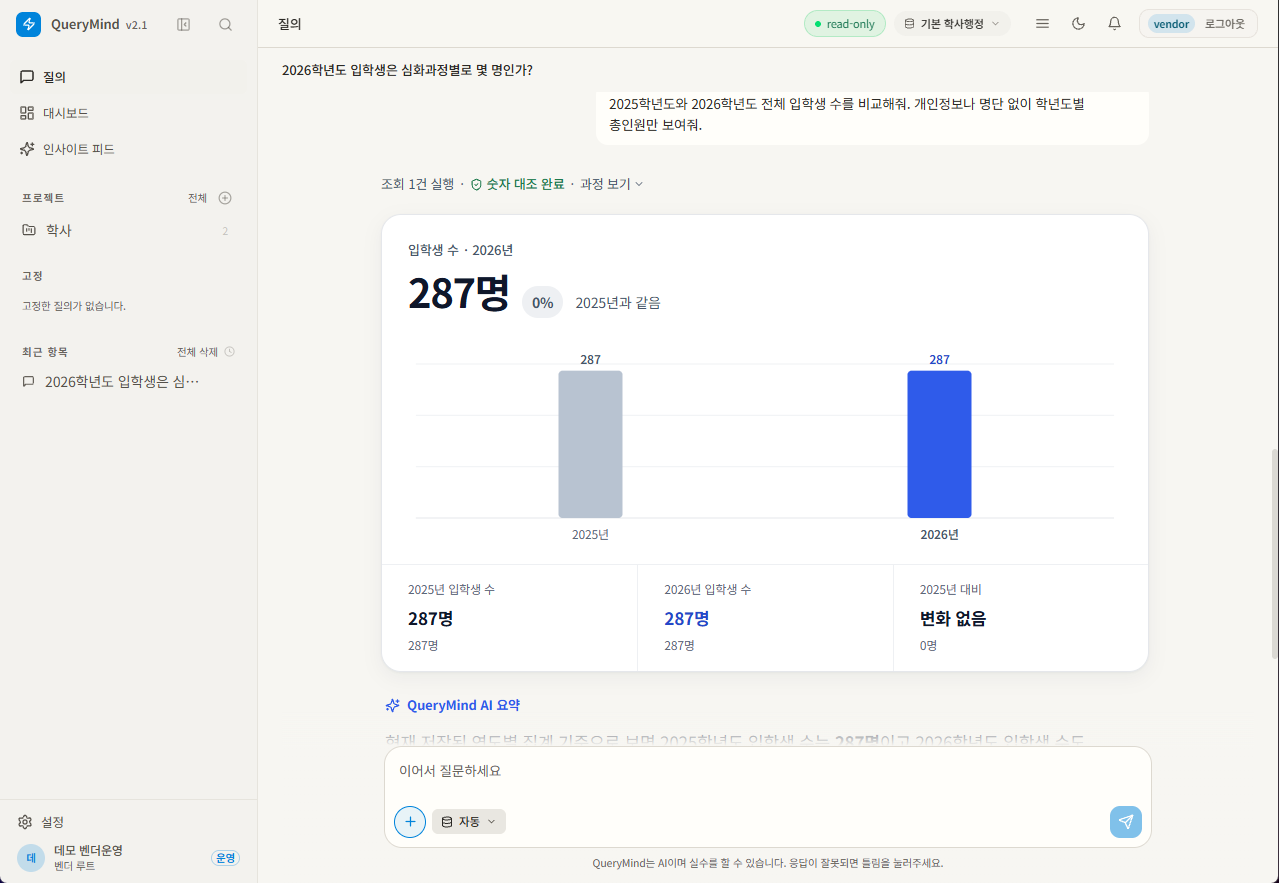
The service opened on this engine: QueryMind
First customer PoC on July 28, 2026; first field deployment on August 12; an Oracle-based university records database connected on August 31; the first real-customer database freeze reported on November 7. The same engine runs in two different worlds, manufacturing ERP and university records, and approved query definitions are published as MCP tools called from Claude and ChatGPT. The repository has accumulated 3,483 commits since June 3.